

How to Hire Software Engineers Remotely in 2026
Last Updated • 15 September 2026
Software engineers are essential to building, maintaining, and scaling modern digital products. From startups developing their first application to established companies expanding their technology departments, finding the right engineering talent can have a direct impact on business growth.
Remote work has made it possible for employers to search beyond their local hiring markets. Instead of limiting recruitment to candidates who live near an office, companies can look for software engineers based on technical expertise, experience, communication, and their ability to work effectively in a distributed team.
But
how do you hire software engineers remotely?
The answer requires more than posting a vacancy online. Employers need a structured recruitment strategy that attracts the right candidates and evaluates whether they can actually succeed in the role.
This guide explains how to hire software engineers remotely, where to find them, what to include in a job posting, and how to build an effective remote engineering hiring process.
Why Hire Software Engineers Remotely?
Remote recruitment allows companies to access a broader pool of engineering talent.
A business in one city may find it difficult to locate a developer with experience in a particular programming language, framework, cloud platform, or industry.
Remote hiring expands the search.
Companies can potentially recruit engineers from different:
- Cities
- Regions
- Countries
- Time zones
- Professional backgrounds
This can be particularly useful for specialized roles such as:
- Senior software engineer
- Full-stack engineer
- Backend engineer
- Front-end engineer
- DevOps engineer
- Cloud engineer
- Data engineer
- AI engineer
- Machine learning engineer
- Mobile engineer
Remote hiring isn't simply about hiring from somewhere else. It allows employers to focus more heavily on finding the skills their business actually needs.
What to Look for When Hiring a Remote Software Engineer
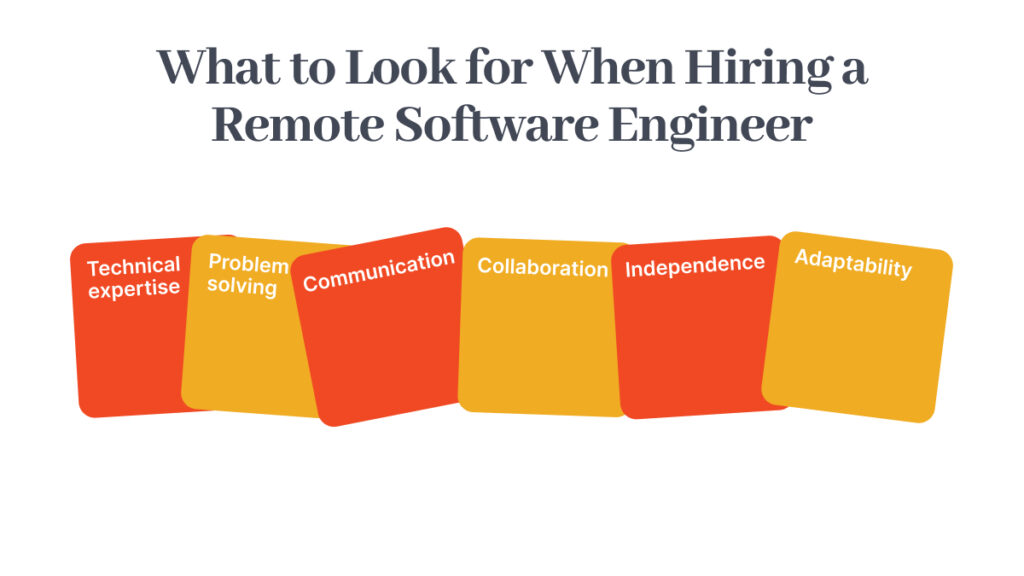
A strong software engineer should bring more than programming knowledge.
Depending on the role, employers should consider several areas.
Technical expertise
Evaluate the programming languages, frameworks, tools, and systems relevant to the position.
Problem-solving
Strong engineers need to understand problems and develop practical solutions.
Communication
Remote teams depend heavily on clear written and verbal communication.
Collaboration
Engineers need to work effectively with developers, designers, product managers, and other stakeholders.
Independence
Remote employees often need to manage their responsibilities without constant supervision.
Adaptability
Technology changes quickly. Engineers who can learn new tools and approaches can provide long-term value to a company.
How to Hire Software Engineers Remotely
01. Define the Engineering Role
Before posting a vacancy, determine exactly what your company needs.
Start with:
- Job title
- Responsibilities
- Technical requirements
- Experience level
- Employment type
- Salary range
- Working hours
- Time-zone requirements
- Remote-work policy
Avoid creating a generic "Software Engineer" position if the role actually requires specific expertise.
For example:
Remote Senior Backend Engineer – Python & Django
is more informative than:
Software Engineer Needed
Specific job titles can also help your vacancy reach candidates searching for particular technical positions.
02. Write an Effective Software Engineer Job Description
A strong job description should explain the position from the candidate's perspective.
Include a short introduction about your company.
Then explain:
What they will do
List the major responsibilities.
What they need to know
Identify essential technical skills.
What they will build
Explain the product, platform, or systems they'll work on.
Who they will work with
Describe the engineering and product team.
How remote work operates
Explain working hours, time zones, meetings, and communication expectations.
What you offer
Include compensation, benefits, flexibility, and professional development opportunities where applicable.
A clear job description helps attract candidates who understand the position before they apply.
03. Post Your Job on the Right Platform
Knowing where to find software engineers online is an important part of recruitment.
Employers can use:
- Technology job boards
- Remote job boards
- Professional networks
- Developer communities
- Recruitment platforms
- Referrals
- Recruitment agencies
A specialized developer job board can be particularly useful when your primary target is technical talent.
CodingProfessors gives employers a platform to publish technology-related job opportunities and reach professionals interested in software development and digital careers.
If you're looking to post a remote developer job, a technology-focused platform can be another valuable channel in your recruitment strategy.
04. Review Technical Experience
Once applications arrive, look beyond the job title on a candidate's resume.
Consider:
- Previous engineering roles
- Projects
- Programming languages
- Frameworks
- Architecture experience
- Industry experience
- Open-source contributions
- Technical portfolios
- GitHub activity where relevant
A candidate's previous work can provide valuable context about their actual capabilities.
However, public repositories should not be treated as the sole measure of someone's engineering ability. Many professional developers work on private codebases that cannot be shared publicly.
05. Conduct an Initial Interview
The first interview should establish whether the candidate is a potential fit.
Discuss:
- Previous experience
- Current responsibilities
- Technical interests
- Availability
- Remote-work experience
- Communication preferences
- Salary expectations
- Time-zone compatibility
This is also an opportunity for the candidate to ask questions.
Remember that remote recruitment works both ways. Candidates are evaluating your company just as much as you're evaluating them.
06. Use a Relevant Technical Assessment
Technical assessments can help employers understand how candidates approach real problems.
Depending on the position, an assessment might involve:
- Writing code
- Debugging
- Designing an API
- Reviewing existing code
- Solving a technical problem
- Designing a software architecture
- Building a small feature
The assessment should be relevant to the actual role.
Avoid tests that require candidates to spend excessive amounts of unpaid time.
A practical, focused assessment can give employers useful information while respecting the candidate's time.
07. Evaluate System Design for Senior Roles
For senior software engineers, technical knowledge goes beyond writing code.
You may need to evaluate their understanding of:
- System architecture
- Scalability
- Databases
- APIs
- Security
- Performance
- Reliability
- Cloud infrastructure
- Monitoring
- Technical trade-offs
A system-design discussion can help determine whether an experienced candidate can make sound architectural decisions.
08. Evaluate Remote Communication
Remote engineering teams rely heavily on communication.
During interviews, consider how candidates:
- Explain technical concepts
- Describe previous problems
- Communicate challenges
- Document information
- Discuss disagreements
- Work with other departments
You don't necessarily need someone who communicates constantly.
You need someone who communicates clearly and effectively.
Remote Software Engineer Hiring Across Time Zones
Global recruitment can create a larger talent pool, but employers need to think carefully about time zones.
A distributed engineering team might have members working in different regions.
That can work well when the company establishes:
- Core collaboration hours
- Flexible working periods
- Clear meeting schedules
- Asynchronous communication
- Written documentation
- Defined response expectations
For example, your company may require engineers to be available for a few hours of overlap each day while allowing them flexibility during the rest of their working time.
These expectations should be communicated before an offer is made.
How to Attract Remote Software Engineers
Experienced engineers often have many options when looking for their next position.
Your company needs to explain why the opportunity is worth considering.
Talk About the Product
Tell candidates what you're building.
Instead of:
"Join our growing technology team."
Explain:
"You'll help build a SaaS platform that enables businesses to automate their daily operations."
Specific information makes the opportunity more tangible.
Explain the Technical Challenge
Engineers often want to work on interesting problems.
Explain what makes the technical work challenging or meaningful.
For example:
- Scaling an application
- Building a new architecture
- Improving performance
- Developing AI features
- Processing large datasets
- Creating reliable infrastructure
Show Career Growth
Explain how engineers can grow within your company.
This might include:
- Technical leadership
- Mentorship
- Learning opportunities
- Ownership of projects
- Exposure to new technologies
- Management opportunities
Be Transparent About Remote Work
Don't use "remote" as a vague benefit.
Explain how your company actually operates remotely.
Tell candidates about:
- Working hours
- Flexibility
- Meetings
- Communication
- Collaboration
- Equipment
- Team structure
How Much Should You Pay a Remote Software Engineer?
Compensation depends on factors such as:
- Experience
- Technical specialization
- Location
- Employment model
- Company size
- Industry
- Responsibilities
There is no universal salary for a remote software engineer.
Instead of attempting to use one global figure, employers should research the relevant market for the specific role and location.
Where possible, providing a compensation range in your job listing can improve transparency.
Full-Time vs. Contract Software Engineers
Remote engineers can be hired under different arrangements.
Full-time
Suitable when you need someone to contribute continuously to the company's product and team.
Contract
Useful for specific projects or periods of development.
Freelance
Can be suitable for short-term or specialized tasks.
The appropriate structure depends on your company's needs and applicable employment requirements.
How to Build a Remote Engineering Hiring Process
A clear process can make recruitment faster and more consistent.
A typical process could look like:
Application → Resume Review → Initial Interview → Technical Assessment → Technical Interview → Final Interview → Offer
Not every company needs all of these stages.
For some positions, a portfolio and technical interview may be sufficient.
For senior roles, additional architecture or leadership discussions may be appropriate.
The important thing is to avoid unnecessary steps.
Common Mistakes When Hiring Remote Software Engineers
Hiring based only on keywords
A resume containing every required technology doesn't guarantee practical expertise.
Overloading the job description
An unrealistic requirements list can discourage strong candidates from applying.
Ignoring communication
Technical ability alone isn't enough for a distributed team.
Taking too long to make a decision
Strong candidates may receive multiple offers.
Not explaining the remote model
Candidates need to know where and when they're expected to work.
Making assessments too long
A technical assessment should respect the candidate's time.
Focusing only on cost
The cheapest candidate isn't necessarily the most valuable hire.
Consider the long-term contribution, experience, reliability, and technical ability of the person you're hiring.
How a Developer Job Board Can Support Remote Hiring
Employers need multiple channels to build a strong recruitment pipeline.
A specialized technology job board can help companies promote technical vacancies to an audience interested in digital careers.
CodingProfessors provides employers with an opportunity to post developer jobs, including remote opportunities, and reach professionals interested in technology and software-related careers.
For startups and growing companies, adding CodingProfessors to your recruitment strategy can provide another channel for finding potential developers and software engineers.
Final Thoughts
Learning how to hire software engineers remotely requires more than finding a website where you can publish a vacancy.
The process starts with defining the role, identifying the right technical requirements, writing a clear job description, and choosing relevant recruitment channels.
From there, employers should evaluate technical expertise, problem-solving, communication, and remote-working ability.
A thoughtful process can help companies find engineers who aren't just technically capable but can also contribute effectively to a distributed team.
If you're ready to expand your engineering team, post your software engineering job on CodingProfessors and reach technology professionals looking for their next opportunity.
Frequently Asked Questions
How can I hire software engineers remotely?
Define the technical requirements of the position, create a detailed job description, publish the vacancy on relevant job boards, screen candidates, conduct interviews, and use a practical technical assessment where appropriate.
Where can I find remote software engineers?
Employers can find remote software engineers through developer job boards, remote hiring platforms, professional networks, developer communities, referrals, and recruitment agencies.
What should I include in a remote software engineer job description?
Include the job title, responsibilities, technical requirements, preferred skills, experience level, compensation, remote-work expectations, working hours, location restrictions, and application process.
How do I evaluate a remote software engineer?
Review relevant experience and projects, conduct interviews, assess technical skills, and evaluate communication and problem-solving abilities. For senior roles, system-design discussions can also be useful.
Should I hire a full-time or contract software engineer?
The right option depends on your business requirements. Full-time engineers can be useful for long-term product development, while contractors and freelancers may be appropriate for specific projects or temporary needs.
How can I attract experienced remote software engineers?
Offer a clear role, explain the technical challenges, communicate compensation and remote-work expectations, and show candidates how their work will contribute to the product and company.

About the Author
Abdul Rehman — Co-Founder & Technical Director, Coding Professors
Abdul Rehman is a web designer and engineer with 3+ years of experience in high-end web design and development. As Co-Founder of Coding Professors, he focuses on making technology careers more accessible through practical guidance, mentorship, and industry-focused resources.