
GPT-6 Astra and the Future of Developers: Is AI Really Replacing Programmers?
Last Updated • 2 October 2026
For years, the question around artificial intelligence and programming was relatively simple:
Can AI write code?
Today, that question is becoming outdated.
The more important question is:
What happens to software developers when AI can reason about a problem, write code, use a computer, test an application and work through a multi-step software task?
The release of GPT-6 Astra has pushed that conversation further.
OpenAI describes GPT-6 Astra as its most capable model, designed for difficult end-to-end work across reasoning, coding, computer use, research and professional tasks. The model is available through the OpenAI API as gpt-6-astra, with a context window of up to 1.05 million tokens and support for multiple reasoning levels.
That naturally raises concerns among programmers.
Will AI replace developers?
Should beginners still learn programming?
And if AI can build software, what exactly is left for the developer to do?
The answer is more interesting than simply saying yes or no.
GPT-6 Astra is changing how software is built. It does not remove the need for software engineering knowledge. Instead, it is pushing developers toward a workflow where understanding, architecture, verification and technical judgment become increasingly important.
What Is GPT-6 Astra?
GPT-6 Astra is OpenAI's flagship model for complex reasoning and end-to-end work.
According to OpenAI's developer documentation, Astra is designed for complex reasoning, coding, computer use, research and document creation. It supports reasoning efforts ranging from low through maximum, allowing developers to choose how much reasoning the model should apply to a task.
Its current API specifications include:
- 1.05 million token context window
- 128,000 maximum output tokens
- Text and image inputs
- Function calling
- Web search
- File search
- Computer use
- Multiple reasoning levels
- Responses API support
OpenAI positions Astra as a model for difficult tasks rather than simply another chatbot that generates text.
That distinction matters for developers.
The biggest shift is not simply that Astra can generate more code.
It is that AI systems are increasingly able to participate in the workflow surrounding the code.
From Code Generation to Software Engineering
Earlier generations of AI coding assistants were primarily useful for generating snippets, explaining errors, completing functions and helping developers write code faster.
A typical workflow looked something like this:
Developer → Prompt → AI generates code → Developer reviews code
With increasingly capable models and agents, the workflow can become much broader:
Developer → Define objective → AI plans → AI writes code → AI uses tools → AI tests → AI iterates → Developer reviews → Software ships
That is a meaningful change.
OpenAI's current coding documentation recommends GPT-6 Astra for API-based code generation because it can handle coding alongside requirements analysis, documentation and broader workflows. OpenAI also provides Codex as a software engineering agent for writing, reviewing and debugging code.
The developer is therefore moving from being only a code producer to becoming a technical director of the development process.
What Makes AI Coding Agents Different?
There is an important difference between an AI assistant and an AI agent.
An AI assistant might answer:
"Here is the JavaScript function you need."
An AI agent can potentially work toward a larger objective.
For example, a developer could provide a task such as:
Build a dashboard that pulls data from an API, displays it in a responsive interface, adds authentication, runs tests and fixes the errors.
The agent can then work through multiple stages of the task using the tools available to it.
OpenAI's computer-use system allows models to interact with browser and desktop interfaces. Developers can use this for tasks such as testing user flows, filling forms and interacting with applications through their interfaces. For GPT-6 Astra, OpenAI recommends code execution as the primary computer-use approach.
This changes the meaning of "AI coding."
It is no longer only about generating a block of code.
It is increasingly about giving an intelligent system a software objective and allowing it to execute parts of the workflow.
Does GPT-6 Astra Mean the End of Developers?
This is where the conversation often becomes exaggerated.
AI can automate parts of software development. That does not mean software engineering as a profession disappears overnight.
There is a fundamental difference between:
writing code
and
engineering a reliable software system.
Code is only one component of software engineering.
A real software project also involves:
- Requirements
- Architecture
- User experience
- Data modeling
- Security
- Testing
- Performance
- Infrastructure
- APIs
- Deployment
- Monitoring
- Maintenance
- Business constraints
- Technical tradeoffs
An AI model can assist with many of these activities.
But someone still needs to determine whether the resulting system actually solves the problem.
That responsibility becomes even more important when AI is capable of making many changes across a codebase.
What Can GPT-6 Astra Help Developers With?
The range of tasks is expanding rapidly.
Code generation
Developers can use Astra to generate functions, components, scripts and larger software implementations.
OpenAI's code-generation documentation specifically recommends gpt-6-astra for applications that need to write code while also reasoning about requirements and documentation.
Debugging
Instead of spending hours searching through an unfamiliar codebase, developers can provide an error, relevant files and expected behavior and ask an AI system to investigate.
The important part is still verification.
An AI-generated fix is a proposed solution, not automatically a correct solution.
Testing
AI can help create tests, identify edge cases and execute testing workflows.
OpenAI's current prompting guidance recommends explicitly requiring testing and validation when using Astra for coding tasks.
Refactoring
Large codebases often contain repetitive or outdated patterns.
AI can help identify opportunities for refactoring and implement changes across multiple files.
Again, testing remains critical.
Documentation
Developers can use AI to explain existing code, create documentation, summarize changes and turn technical information into material that other team members can understand.
Prototyping
One of the biggest advantages may be speed.
An idea that previously required days of implementation can potentially become a working prototype much faster.
This changes the economics of experimentation.
The Developer's Role Is Changing
The biggest mistake developers can make is assuming that AI makes technical knowledge unnecessary.
In reality, the opposite can happen.
When AI generates code faster, the ability to understand that code becomes more valuable.
Imagine two developers receive the same AI-generated backend.
Developer A accepts it because the code looks correct.
Developer B asks:
- Is the authentication secure?
- What happens when the database fails?
- Is this query vulnerable to injection?
- Does this scale?
- What happens with 100,000 users?
- Are errors handled correctly?
- Are sensitive credentials exposed?
- What happens if the API returns unexpected data?
Developer B is doing software engineering.
AI can help both developers write code.
But technical knowledge determines how effectively they can evaluate what AI produces.
Is GPT-6 Astra AGI?
The release of increasingly capable AI models has also intensified the discussion around Artificial General Intelligence, or AGI.
AGI does not have one universally accepted technical definition.
Generally, the term refers to an AI system with broad intellectual capabilities that can perform a wide range of tasks rather than being narrowly optimized for one specific problem.
GPT-6 Astra clearly expands the range of tasks AI can perform.
OpenAI describes it as state-of-the-art across areas including computer use, browsing, software engineering, cybersecurity, science and professional work. OpenAI also reports strong results across several advanced evaluations.
But benchmark performance alone does not settle the broader philosophical or technical question of whether a particular system qualifies as AGI.
For developers, the more practical question is:
How capable are these systems becoming at performing real-world work?
And that answer is already changing quickly.
Why Computer Use Matters
One of the most important developments is not necessarily code generation.
It is computer use.
OpenAI's computer-use tooling allows a model to interact with browser and desktop interfaces using screenshots and tool outputs. Applications can use this capability to test workflows and operate software interfaces.
Think about the difference.
A traditional coding model might tell you how to test a website.
A computer-using agent can potentially interact with the website itself.
That opens the door to workflows such as:
Build → Run → Inspect → Test → Find problem → Modify → Test again
The closer AI gets to completing that loop reliably, the more software development changes.
What Developers Should Learn Now
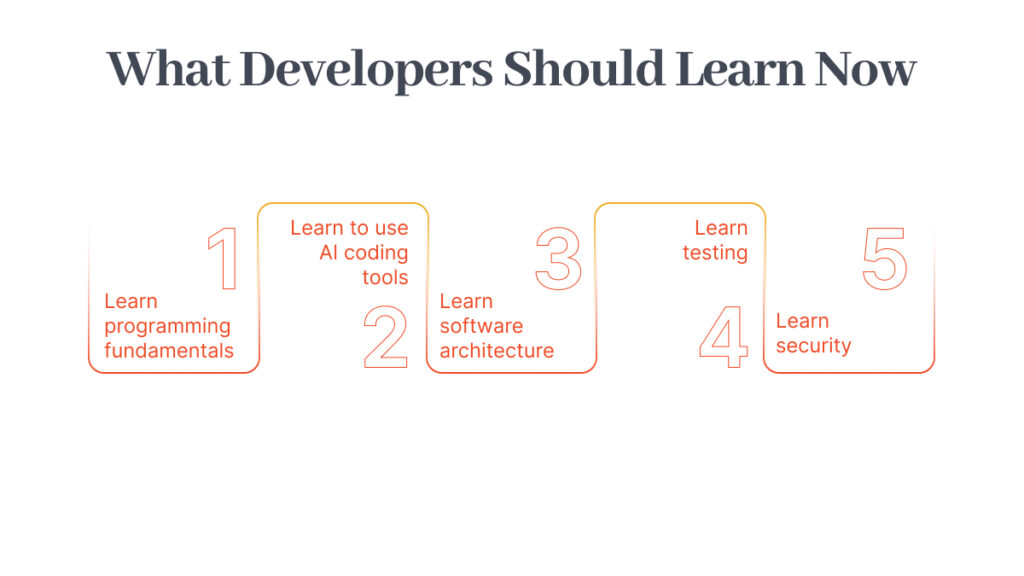
If you are a developer reading this and wondering whether you should change your career plans, there is a more productive response than trying to predict the future.
Start adapting now.
1. Learn programming fundamentals
Do not abandon programming fundamentals because AI can write code.
Learn:
- Variables
- Functions
- Data structures
- Algorithms
- Object-oriented programming
- Asynchronous programming
- Error handling
- APIs
- Databases
You do not need to memorize every syntax pattern.
You do need to understand what the code is doing.
2. Learn to use AI coding tools
AI should become part of your development workflow.
Use it for:
- Debugging
- Documentation
- Code explanations
- Test generation
- Prototyping
- Refactoring
- Research
- Code review
The goal is not to let AI think instead of you.
The goal is to make yourself more productive with it.
3. Learn software architecture
This may become one of the most valuable developer skills.
If AI can generate an implementation, developers need to become better at deciding:
What should we build?
How should it be structured?
Which technologies should we use?
How should the components communicate?
What happens when something fails?
Architecture is where technical decisions become more important than syntax.
4. Learn testing
Never assume AI-generated code is correct.
Write tests.
Run tests.
Check edge cases.
Review the actual output.
OpenAI's current coding guidance explicitly recommends giving coding agents clear testing and validation requirements.
5. Learn security
As AI gains the ability to operate software and computer systems, security becomes even more important.
OpenAI's safety assessment classifies GPT-6 Astra at the Critical level for cybersecurity capability, reporting that with appropriate tools and access it can identify previously unknown vulnerabilities and develop exploitation methods across protected systems.
That means developers need to understand not only how to build software, but also how to protect it.
The New Developer Skill Stack
The developer of the future may need a broader skill set than the developer of the past.
Think of it as five layers.
Layer 1: Programming
Learn how software works.
Layer 2: Engineering
Learn Git, testing, APIs, databases, deployment and debugging.
Layer 3: AI
Learn AI-assisted development, prompting, context management and coding agents.
Layer 4: Architecture
Learn system design, scalability, performance, reliability and security.
Layer 5: Human Judgment
Learn communication, product thinking, problem solving and technical decision-making.
AI can assist across all five.
But developers still need to understand all five to use that assistance effectively.
What About Junior Developers?
This is one of the hardest questions in the AI era.
A significant amount of entry-level programming work involves repetitive implementation, basic debugging, documentation and straightforward feature development.
Those are precisely the areas where AI assistance is becoming increasingly capable.
That means junior developers should not build their careers around simply producing repetitive code.
Instead, they should use AI to accelerate learning while developing stronger fundamentals.
A junior developer who uses AI to build something without understanding it may become dependent on the tool.
A junior developer who uses AI to explain concepts, experiment, test ideas and then studies the underlying implementation can potentially learn faster.
The distinction is simple:
Use AI as a teacher, pair programmer and productivity tool. Do not use it as a substitute for learning.
The Future Is Not "AI vs Developers"
The more useful way to look at this transition is:
Developer + AI
rather than:
Developer vs AI
A developer working alone might spend hours implementing a feature.
A developer working with an AI coding agent can potentially spend more time defining requirements, reviewing architecture and validating the final result.
The tool changes.
The responsibility remains.
And that responsibility may become more technical, not less.
What Should Developers Do Today?
If you are a developer, start with a practical roadmap.
Keep coding.
Then add AI to the workflow.
Build a project using an AI coding assistant.
Give it a real problem instead of a toy prompt.
Ask it to explain its decisions.
Make it write tests.
Review the generated code.
Break the implementation deliberately.
Ask the AI to debug it.
Then fix the remaining problems yourself.
That process teaches something that tutorials alone cannot:
how to work with AI without becoming dependent on it.
Final Thoughts
GPT-6 Astra represents an important shift in software development because the conversation is moving beyond AI that simply generates code.
We are entering a workflow where AI models can reason through complex tasks, interact with computers, use tools, write software and participate in longer development processes. OpenAI's current developer guidance reflects this shift, including support for computer use, coding agents, asynchronous tool calls and mid-task steering.
That does not make programming irrelevant.
It makes the definition of programming broader.
The developer who only knows how to type code may find more of their work automated.
The developer who understands why the code exists, how systems should work, how to test them, how to secure them and how to direct AI effectively has a different set of opportunities.
The future developer may write fewer lines of code.
But they may be responsible for building much more software.
And that is the shift developers should be preparing for now.
Frequently Asked Questions
What is GPT-6 Astra?
GPT-6 Astra is OpenAI's flagship model designed for complex reasoning, coding, computer use, research and professional workflows. It is available through the OpenAI API as gpt-6-astra.
Will GPT-6 Astra replace software developers?
GPT-6 Astra can automate or accelerate many software-development tasks, including coding, debugging, testing and broader workflows. However, software engineering also involves architecture, requirements, security, testing, deployment and technical decision-making. The impact therefore depends on which parts of a developer's work are being performed.
Should I still learn programming?
Yes. Programming fundamentals remain useful for understanding, reviewing, debugging and directing AI-generated software. Developers should combine programming knowledge with AI-assisted development skills.
Is GPT-6 Astra AGI?
GPT-6 Astra has broad capabilities across reasoning, coding, computer use, research and other domains, but whether a particular model meets a given definition of AGI depends on how AGI is defined. There is no single universally accepted test that resolves the question.
Can GPT-6 Astra write software?
Yes. OpenAI specifically positions GPT-6 Astra for software engineering and code generation. Developers can use it to write, review and reason about code through the OpenAI API and related coding tools.
What skills should developers learn for the AI era?
Developers should continue learning programming fundamentals while adding software architecture, testing, security, AI-assisted development, coding agents, APIs, databases and system design to their skill set.
What is an AI coding agent?
An AI coding agent is a system that can perform multi-step software-development tasks using tools rather than only generating individual code snippets. Depending on the environment, it can inspect files, modify code, run commands, test changes and iterate toward a specified goal.
How can developers prepare for GPT-6 Astra?
Start using AI in real development projects while strengthening fundamentals. Learn how to give agents clear tasks, provide appropriate context, require testing, review generated code and understand the architecture behind the software you build.

About the Author
Abdul Rehman — Co-Founder & Technical Director, Coding Professors
Abdul Rehman is a web designer and engineer with 3+ years of experience in high-end web design and development. As Co-Founder of Coding Professors, he focuses on making technology careers more accessible through practical guidance, mentorship, and industry-focused resources.