

Best Platforms for Hiring Remote Tech Talent in 2026
Last Updated • 10 September 2026
Hiring technology professionals has changed significantly in recent years. Companies are no longer restricted to candidates who live near their offices, and remote work has opened access to a much larger global talent pool.
But having access to more candidates doesn't automatically make hiring easier.
The real challenge is finding qualified remote tech talent without spending excessive time sorting through irrelevant applications.
That is why choosing the right remote hiring platform matters.
Whether you're a startup, technology company, digital agency, or growing business, the right platform can help you reach developers, software engineers, designers, and other technology professionals who are actively looking for new opportunities.
In this guide, we'll look at what employers should consider when choosing a platform for remote hiring and how a specialized technology job board can support your recruitment strategy.
What Is a Remote Hiring Platform?
A remote hiring platform connects employers with professionals who are available for remote work.
Depending on the platform, companies may be able to:
- Post remote job openings
- Reach candidates in different locations
- Search for technical professionals
- Promote job opportunities
- Receive applications
- Organize candidate information
- Recruit for full-time or contract positions
Some platforms serve a broad range of industries, while others specialize in specific professions.
For companies hiring developers and technology professionals, a tech-focused hiring platform can provide a more relevant audience.
Why Companies Are Hiring Remote Tech Talent
Technology companies have traditionally competed for talent within specific cities and regions.
Remote work has changed that model.
A company can now potentially recruit a developer based in another city or country without requiring relocation.
This provides access to professionals with specialized skills that may be difficult to find locally.
Companies are hiring remote professionals for roles including:
- Software developers
- Software engineers
- Full-stack developers
- Front-end developers
- Back-end developers
- Mobile developers
- DevOps engineers
- Data engineers
- AI engineers
- Machine learning specialists
- UI/UX designers
- Product designers
- QA engineers
For employers, the advantage is not simply geographical flexibility. It is the ability to search for talent based on skills and experience rather than location alone.
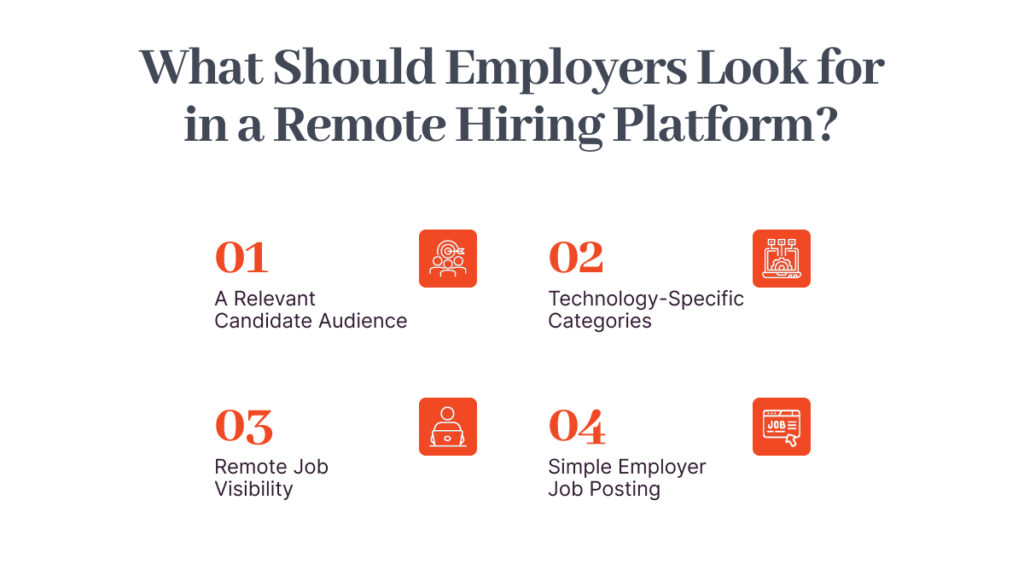
What Should Employers Look for in a Remote Hiring Platform?
Not every hiring platform is equally useful for every company.
Before choosing where to publish a vacancy, consider the following factors.
01. A Relevant Candidate Audience
The most important factor is the audience.
If you're hiring a software developer, you want your vacancy to reach people interested in software development.
If you're hiring an AI engineer, you want professionals with an interest or background in artificial intelligence and machine learning.
A platform that attracts technology professionals can therefore be more relevant than a general employment website.
02. Technology-Specific Categories
Categories help both employers and candidates.
A good technology-focused job board should make it easy to organize opportunities according to areas such as:
- Development
- Programming
- Software engineering
- Design
- Data
- IT
- Artificial intelligence
- Cybersecurity
This makes it easier for candidates to discover jobs that match their skills.
03. Remote Job Visibility
If you're recruiting remotely, candidates should be able to identify remote opportunities quickly.
Your job listing should clearly communicate whether the role is:
- Fully remote
- Remote within a particular country
- Remote within a specific region
- Remote with time-zone restrictions
- Hybrid
Clear remote information can improve the relevance of applications.
04. Simple Employer Job Posting
Recruitment shouldn't require unnecessary complexity.
A useful job board for employers should make it straightforward to publish a vacancy.
The employer should be able to provide:
- Job title
- Company details
- Job description
- Responsibilities
- Skills
- Experience
- Location
- Remote status
- Compensation
- Application information
The faster you can publish a clear job opportunity, the sooner candidates can discover it.
General Hiring Platforms vs. Technology Job Boards
A general hiring platform can be useful when you're recruiting for a wide variety of positions.
However, technology roles can require highly specific skills.
Consider a company looking for a senior React developer.
The employer isn't simply looking for someone with general professional experience. They're looking for someone familiar with a specific technology stack and capable of working on complex software projects.
A specialized technology job board can help put that opportunity in front of an audience already interested in technical careers.
This can make your recruitment strategy more targeted.
CodingProfessors for Remote Tech Hiring
CodingProfessors provides a technology-focused environment where employers can publish job opportunities for developers and other digital professionals.
For companies looking to hire remote developers, this provides an opportunity to place their vacancies in front of a relevant technology audience.
Instead of treating every job as a generic vacancy, employers can focus their recruitment efforts around the skills and roles they actually need.
CodingProfessors can be useful for companies recruiting:
- Developers
- Programmers
- Software engineers
- Designers
- Digital professionals
- Technology specialists
Whether you're hiring for one position or building an entire technology team, publishing your opportunity on a relevant platform is an important part of reaching potential candidates.
How to Choose the Right Platform for Your Company
The best remote hiring platform for your company depends on what you're trying to accomplish.
Ask yourself these questions before choosing a platform:
Who am I trying to hire?
A platform that specializes in technology may be more suitable if you're looking for developers or engineers.
Where can the candidate work?
If your company accepts applications globally, communicate this clearly.
If there are location or time-zone restrictions, include them in the job listing.
What skills are required?
Highly specialized roles benefit from platforms where candidates actively search for those skills.
How quickly do I need to hire?
If you're trying to fill a position quickly, look for platforms that make job publishing and candidate discovery straightforward.
What type of employment are you offering?
Be clear about whether you're hiring:
- Full-time employees
- Part-time employees
- Contractors
- Freelancers
- Temporary workers
This helps candidates understand exactly what you're offering.
How to Attract Better Remote Candidates
Choosing the right platform is only half of the process.
Your job listing also needs to attract the right people.
Create a Specific Job Title
Compare:
Developer Needed
with:
Remote Senior Full-Stack Developer – React, Node.js & PostgreSQL
The second option tells candidates much more about the position.
Specific job titles can also capture searches from candidates looking for particular roles.
Explain the Work
Candidates want to know what they'll actually be doing.
Explain:
- What product they'll work on
- What problems they'll solve
- What their responsibilities are
- Who they'll collaborate with
- What technologies they'll use
Avoid relying entirely on a generic list of requirements.
Explain Your Remote Culture
Posting a job is only the beginning. Your listing needs to give qualified professionals a reason to apply.
Highlight the Opportunity
Remote professionals often want to know how a company operates.
Consider explaining:
- How teams communicate
- How meetings are handled
- How projects are managed
- How performance is evaluated
- How employees collaborate
- How flexible working hours are
This gives candidates a better understanding of what working remotely for your company actually means.
How to Hire Remote Developers Efficiently
Finding developers is easier when your hiring process is structured.
A simple process might look like this:
Step 1: Publish the job
Create a clear vacancy with specific technical requirements.
Step 2: Review applications
Focus on relevant experience and demonstrated skills.
Step 3: Review portfolios
For developers, previous projects can provide valuable context.
Step 4: Conduct an initial interview
Discuss experience, communication, expectations, and availability.
Step 5: Complete a technical assessment
Use a practical assessment relevant to the actual position.
Step 6: Conduct a final interview
Discuss the role, team, compensation, and expectations.
Step 7: Make the offer
Once you've identified the right candidate, move quickly.
Strong technical candidates may be considering multiple opportunities.
Benefits of Hiring Remote Tech Talent
Remote recruitment can provide several benefits for employers.
Larger talent pool
Companies can search beyond their immediate geographical area.
Access to specialized skills
Employers can look for professionals based on specific technical capabilities.
Flexible team building
Businesses can build distributed teams across different locations.
Potential cost flexibility
Depending on the company and location, remote hiring may provide flexibility in workforce costs.
Faster access to talent
Companies don't necessarily need to wait for candidates to relocate.
However, remote hiring should still be approached strategically. Communication, employment regulations, time zones, and team collaboration need to be considered before hiring internationally.
Long-Term Remote Hiring Strategy
Remote recruitment shouldn't only be used when a company desperately needs someone.
Businesses can build a stronger talent pipeline by consistently communicating their hiring needs and maintaining a presence where technology professionals search for opportunities.
For example, a growing startup may regularly need:
- Software developers
- Product designers
- QA engineers
- DevOps specialists
- Data professionals
Maintaining an active presence on a developer job board can make it easier to promote opportunities as new positions become available.
Common Mistakes When Choosing a Remote Hiring Platform
Choosing based only on audience size
A huge audience doesn't necessarily mean the right audience.
For technical recruitment, relevance can be more important than raw traffic.
Using only general job boards
General platforms can be useful, but specialized technology roles may benefit from specialized recruitment channels.
Not comparing job visibility
Your vacancy needs to be discoverable by candidates.
Ignoring the employer experience
If posting and managing jobs is unnecessarily complicated, it can slow down recruitment.
Failing to define the target candidate
Before choosing a platform, understand exactly who you're trying to reach.
The Future of Remote Technology Recruitment
Remote work continues to influence how companies build technology teams.
Instead of asking:
"Who can work in our office?"
employers can increasingly ask:
"Who has the skills we need?"
That shift creates opportunities for both companies and technology professionals.
The platforms that help connect the two sides will become increasingly important as businesses continue building distributed teams.
Final Thoughts
Choosing the right remote hiring platform can make a significant difference when you're trying to find qualified technology professionals.
Employers should consider audience relevance, technology categories, remote-work support, job visibility, ease of posting, and the overall quality of candidates they can reach.
For companies looking to hire remote developers, software engineers, designers, and other technology professionals, CodingProfessors offers a focused environment for publishing technology-related opportunities.
If your company is ready to expand its technical team, post your next job on CodingProfessors and start reaching technology professionals looking for their next opportunity.
Frequently Asked Questions
What is the best platform for hiring remote tech talent?
The best platform depends on the role, location, skills, and hiring requirements. Companies hiring developers and technology professionals should consider technology-focused job boards and remote hiring platforms.
Where can I find remote tech talent?
Employers can find remote tech talent through specialized job boards, technology recruitment platforms, professional networks, developer communities, and referrals.
What is a remote hiring platform?
A remote hiring platform helps employers connect with professionals who are interested in working remotely. Depending on the platform, employers may be able to publish vacancies, reach candidates, and manage applications.
How can I hire remote developers?
Start by defining the technical requirements, creating a detailed job description, publishing the opportunity on a relevant developer job board, and using interviews and technical assessments to evaluate candidates.
Are specialized technology job boards better for hiring developers?
They can be useful because they provide access to an audience specifically interested in technology careers. Employers can combine specialized job boards with other recruitment channels to reach a broader candidate pool.
How can startups find remote developers?
Startups can use developer job boards, remote hiring platforms, professional networks, referrals, and technology communities. A clear job description and compelling company proposition can help attract qualified developers.

About the Author
Abdul Rehman — Co-Founder & Technical Director, Coding Professors
Abdul Rehman is a web designer and engineer with 3+ years of experience in high-end web design and development. As Co-Founder of Coding Professors, he focuses on making technology careers more accessible through practical guidance, mentorship, and industry-focused resources.