
Bubble AI Review: I Built a Functional Streetwear Marketplace with One Prompt
Last Updated • 17 November 2026
Can AI build a complete marketplace with product listings, shopping interactions, and a premium storefront design? In this episode of Al Developer Lab by Coding Professors, I explored
Bubble AI
to find out.
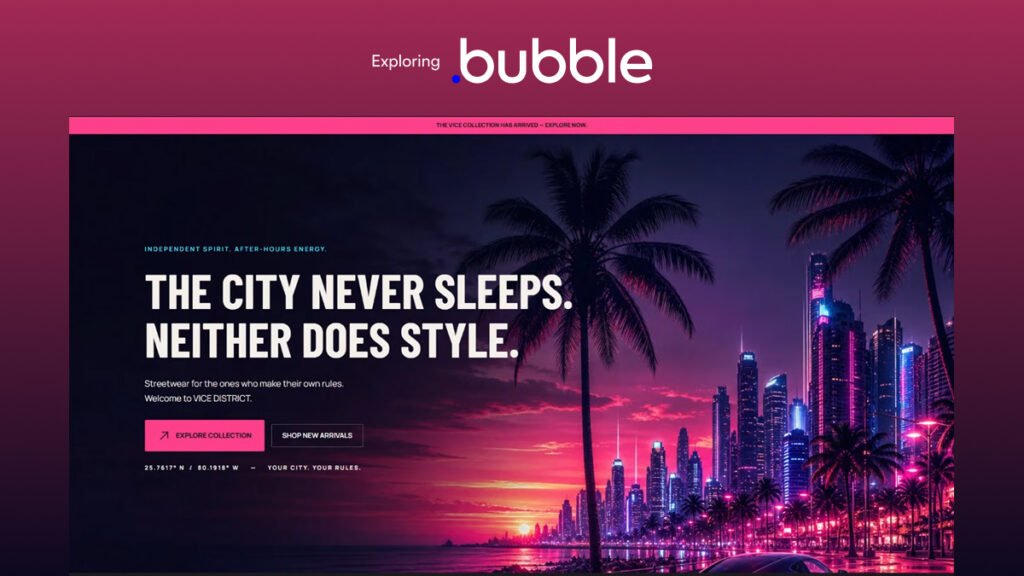
For this experiment, I challenged Bubble to create a modern streetwear marketplace inspired by GTA Vice City and the upcoming GTA 6. The concept included a distinctive brand identity, product categories, hero imagery, and an online shopping experience.
The goal was to see how well Bubble could turn a detailed English prompt into a functional web application.
Getting Started with Bubble AI
Bubble offered a noticeably different starting experience compared with many other AI website builders.
Instead of a dashboard filled with menus and options, the initial interface presented a simple chat box where I could enter my prompt.
There was a 2,500-character prompt limit, so I had to keep the instructions within that restriction.
Before generating the project, Bubble also provided two screen options:
- Web: For website and web application development.
- Mobile: For mobile-focused application development.
Since my challenge was an online marketplace, I selected the web option and started building.
Building a Streetwear Marketplace with AI
After submitting the prompt, Bubble began planning and generating the application.
The generation process took approximately 10 minutes. Once completed, it presented a web application for review.
The result was impressive, particularly in terms of its visual design and layout consistency.
Bubble generated a complete storefront concept with:
- A distinctive brand identity.
- A visually engaging hero section.
- Product and shopping categories.
- Product cards and mockups.
- Multiple content sections.
- Interactive animations.
- A complete footer.
What stood out was that the platform did more than place text over generic backgrounds. The individual sections had their own visual treatment, while maintaining a consistent design direction.
The grid system, spacing, typography, and sizing also looked well coordinated throughout the website.
Design Quality and User Experience
The generated marketplace was one of the strongest visual results in this experiment.
The hero section and product mockups looked particularly impressive. Product cards were presented in a consistent layout, and the different sections felt like parts of one cohesive storefront.
I also explored the animations and interactive elements. The transitions and visual interactions added to the overall shopping experience.
The footer was another positive detail, helping the website feel more complete rather than like a collection of disconnected generated sections.
Testing the Shopping Functionality
A visually attractive storefront is not enough for an e-commerce application. I wanted to see whether the product interactions actually worked.
I selected a product and tested the available shopping options.
The application allowed me to:
- Select a product size.
- Choose a color.
- Adjust the quantity.
- Add the product to the cart.
The add-to-cart interaction worked during my test.
This was an important result because it demonstrated that the generated application included working shopping interactions, rather than only static product mockups.
However, I did not test payment processing, order management, authentication, or a complete production checkout workflow. Those capabilities should be evaluated separately before using the application for a real business.
Bubble Editor, Canvas, and Development Tools
After generation, I explored the Bubble canvas and its development interface.
The platform provided options to preview the application in a separate window, debug the project, request changes, and explore suggested features.
I could also inspect the workflow and design options within the editor.
Some features were restricted in the free experience, so I could not fully explore every development and publishing capability.
Deployment also required upgrading during my experiment.
Bubble AI Pricing
During the pricing exploration, the Starter plan was displayed at $39 per month.
This is the price shown during my recording, so check Bubble's official pricing page for the latest plan details, limits, and billing options before subscribing.
For users considering Bubble for a serious project, it is worth comparing the available plans against their development and deployment requirements.
Final Verdict: Is Bubble AI Worth Trying?
My verdict: 9.5/10 — highly recommended for this experiment.
Bubble impressed me with its ability to transform a relatively detailed prompt into a visually polished marketplace application.
The design consistency, product presentation, animations, and overall layout were excellent. More importantly, I was able to test product options and add-to-cart functionality successfully.
The approximately 10-minute generation time also made the experience particularly interesting.
There are still important considerations. Deployment required an upgrade, several features were restricted in the free experience, and I did not test the complete backend, payment, or order-processing workflow.
Nevertheless, Bubble is one of the strongest tools I explored in this AI Developer Lab experiment.
If you want to build web applications with AI and continue developing them through a visual development environment, Bubble is definitely worth exploring.
Tested by Coding Professors — AI Developer Lab.

About the Author
Abdul Rehman — Co-Founder & Technical Director, Coding Professors
Abdul Rehman is a web designer and engineer with 3+ years of experience in high-end web design and development. As Co-Founder of Coding Professors, he focuses on making technology careers more accessible through practical guidance, mentorship, and industry-focused resources.