

How to Post Remote Jobs and Attract Qualified Candidates in 2026
Last Updated • 15 September 2026
Remote hiring has become an important part of how modern companies build teams. Businesses can now recruit developers, designers, engineers, marketers, and other professionals without requiring them to work from a traditional office.
But posting a remote vacancy is only the first step.
The real challenge is attracting qualified remote candidates who have the skills, experience, and availability required for the position.
A poorly written job posting can generate hundreds of irrelevant applications. A clear and targeted posting can help employers reach professionals who are genuinely suited to the role.
In this guide, we'll explain how to post remote jobs, where employers can publish vacancies, how to write better job descriptions, and how to attract qualified candidates in 2026.
Why Remote Job Posting Matters
The platform where you publish a vacancy can influence the type of candidates who discover it.
If you're hiring a software developer, for example, posting your position on a general employment website may expose it to a broad audience.
But your objective isn't necessarily to receive the largest number of applications.
Your objective is to reach the right candidates.
This is why employers should consider both the quality of the job listing and the relevance of the platform where it is published.
What Is a Remote Job Posting?
A remote job posting is a vacancy advertised for a position that can be performed outside a traditional company office.
Depending on the company, the role may be:
- Fully remote
- Remote within a specific country
- Remote within a specific region
- Remote with time-zone requirements
- Hybrid
- Remote with occasional office visits
Employers should clearly explain which model applies to the position.
Simply writing "Remote" isn't always enough.
How to Post a Remote Job
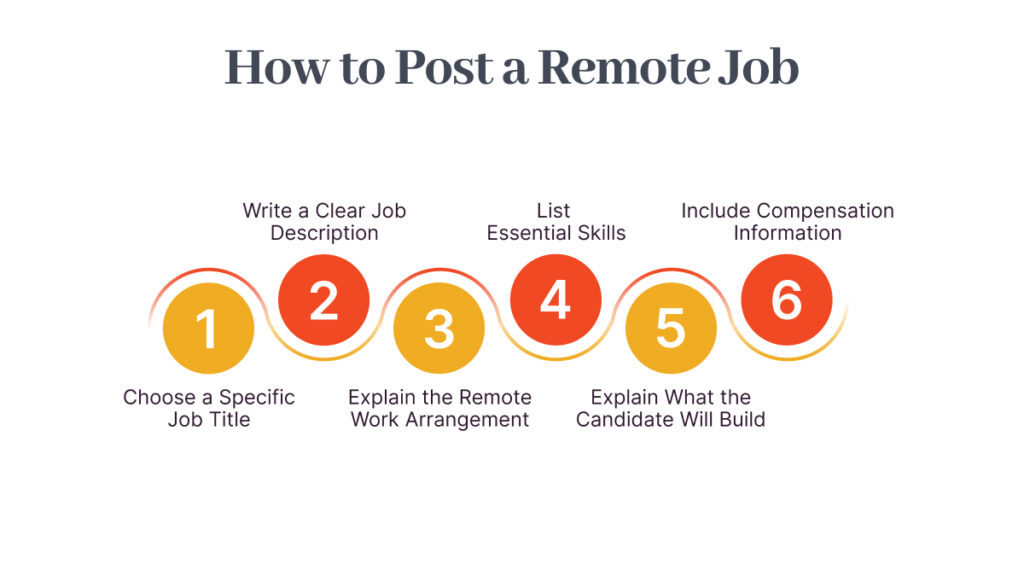
01. Choose a Specific Job Title
The job title is one of the first things candidates see.
Avoid vague titles such as:
Developer Needed
Instead, use something specific:
Remote Full-Stack Developer – React & Node.js
Or:
Remote Senior UI/UX Designer – SaaS Products
A specific job title communicates the opportunity immediately and can help your vacancy appear in relevant candidate searches.
02. Write a Clear Job Description
A strong remote job description should answer the questions candidates are likely to have.
Explain:
- What the company does
- Why you're hiring
- What the employee will do
- Required skills
- Preferred qualifications
- Experience level
- Salary or compensation
- Benefits
- Working hours
- Remote-work expectations
- Location restrictions
- Application process
The candidate should understand the role without needing to contact the employer for basic information.
03. Explain the Remote Work Arrangement
One of the biggest mistakes employers make is using "remote" without explaining what it actually means.
Include details such as:
Location
Can candidates work from anywhere?
Or must they be located in a particular country?
Time Zone
Do employees need to work within specific hours?
Meetings
Are there regular team meetings?
Availability
Are employees expected to be online during particular hours?
Travel
Is occasional travel required?
Equipment
Does the company provide a laptop or other equipment?
04. List Essential Skills
Don't turn your job description into a list of every technology your company has ever used.
Focus on what the employee actually needs.
For example, if you're hiring a React developer, you might list:
- React
- JavaScript
- TypeScript
- HTML
- CSS
- Git
- API integration
Then separate additional skills into a "Preferred" section.
This allows qualified candidates who don't match every optional requirement to consider applying.
05. Explain What the Candidate Will Build
Candidates want to understand the work behind the job title.
Instead of saying:
"Develop and maintain web applications."
Explain what they'll actually work on.
For example:
"You'll help build and improve a SaaS platform used by businesses to manage their daily operations."
This provides context and can make the position much more appealing.
06. Include Compensation Information
Salary transparency can help attract serious candidates.
Where possible, include:
- Salary range
- Hourly rate
- Contract rate
- Performance bonuses
- Benefits
- Other compensation
If the salary depends on location or experience, explain the structure.
Clear compensation information can also reduce applications from candidates whose expectations are far outside your budget.
Where Should Employers Post Remote Jobs?
There are many places where companies can advertise remote vacancies.
These include:
- General job boards
- Remote job boards
- Technology job boards
- Professional networks
- Developer communities
- Recruitment agencies
- Industry-specific platforms
- Employee referral networks
The best option depends on the role you're trying to fill.
For example, a company hiring a software engineer may benefit from publishing the opportunity on a developer job board where technology professionals actively search for opportunities.
Why Employers Should Consider a Technology Job Board
General job boards provide broad exposure.
Specialized platforms provide targeted exposure.
If you're hiring:
- Software developers
- Software engineers
- Programmers
- DevOps engineers
- Data engineers
- UI/UX designers
- Product designers
- IT professionals
a technology-focused platform can help you reach a more relevant audience.
CodingProfessors provides employers with a platform to post technology jobs and remote opportunities, helping companies connect with professionals interested in software development, design, and digital careers.
For employers, this can complement broader recruitment channels and create another source of qualified candidates.
How to Attract Qualified Remote Candidates
Getting your job posting in front of candidates is only part of the process.
You also need to make the opportunity attractive.
Highlight the Product
Tell candidates what your company is building.
People are more likely to engage with a job when they understand the product and its purpose.
Explain the Impact
Show candidates how their work will contribute to the company.
For example:
"You'll be one of the first engineers helping us build the platform from the ground up."
This communicates ownership and impact.
Highlight Flexibility
If your company genuinely offers flexible work, explain what that means.
For example:
- Flexible working hours
- Async communication
- Flexible time off
- Remote-first culture
- Flexible location
Don't advertise flexibility if employees are actually expected to follow rigid office-style schedules.
Explain Career Growth
Candidates want to know what happens after they join.
Mention opportunities such as:
- Leadership
- Mentorship
- Training
- Technical ownership
- Professional development
- Promotion
How to Write a Job Description Developers Actually Want to Read
Technical candidates often respond better to job descriptions that are specific.
Avoid excessive corporate language.
Instead of:
"We are seeking a passionate rockstar developer to join our dynamic and innovative team."
Say:
"We're looking for a senior backend engineer to help us scale our API and infrastructure."
The second version immediately communicates the actual opportunity.
Keep the Requirements Realistic
A job description requiring:
- 10 programming languages
- 15 frameworks
- 8 cloud technologies
- 10 years of experience
may discourage strong candidates from applying.
Ask yourself:
Does the candidate genuinely need this skill to perform the job?
If not, move it to the preferred section—or remove it.
How to Improve Remote Job Applications
Your application process should be simple.
Only ask candidates for information that you actually need.
Depending on the position, you might request:
- Resume
- Portfolio
- LinkedIn profile
- GitHub profile
- Short introduction
- Relevant work samples
Avoid forcing candidates through unnecessary forms and repetitive questions.
A simpler application process can reduce friction.
How to Screen Remote Candidates
Once applications arrive, create a consistent screening process.
Review Relevant Experience
Look for experience that relates directly to the position.
Review Portfolios
For developers and designers, previous work can provide useful context.
Conduct an Initial Interview
Discuss experience, communication, availability, and expectations.
Use Skills Assessments
For technical positions, consider a practical assessment relevant to the actual job.
Conduct a Final Interview
Discuss the role, company, team, compensation, and expectations.
Don't Confuse More Applications With Better Hiring
One of the biggest misconceptions in recruitment is that more applications automatically mean better hiring.
Imagine two job postings.
Job A
Receives 500 applications, but only 15 are relevant.
Job B
Receives 80 applications, with 35 highly relevant candidates.
Job B may provide a much better hiring outcome.
Employers should therefore focus on candidate quality and relevance, not simply application volume.
How to Post Remote Developer Jobs More Effectively
If you're hiring developers, optimize the vacancy around the actual technical role.
Include:
- Programming language
- Framework
- Experience level
- Product type
- Development responsibilities
- Remote location
- Time-zone requirements
- Salary
- Employment type
For example:
Remote Senior Python Developer – Django & PostgreSQL
is much more useful than:
Senior Developer Wanted
The more specific your vacancy, the easier it is for the right candidates to recognize that it is relevant to them.
Remote Hiring for Startups
Startups often need to move quickly.
They may need developers to build an MVP, designers to establish the product experience, or engineers to scale an existing application.
Remote hiring can help startups expand their search beyond their local talent market.
However, startups should be particularly careful about communicating:
- Company stage
- Product vision
- Funding status where relevant
- Responsibilities
- Ownership
- Compensation
- Expected working hours
- Remote culture
Early employees often take on significant responsibility, so candidates need to understand what they're joining.
Remote Hiring for Growing Companies
Larger companies may already have established recruitment processes.
For them, remote job boards can serve as an additional candidate acquisition channel.
Companies can use multiple recruitment sources simultaneously:
Company careers page + professional networks + specialized job boards + referrals
This creates a broader recruitment pipeline without relying entirely on one platform.
Common Mistakes When Posting Remote Jobs
Using a vague job title
Candidates may not understand what position you're offering.
Hiding the remote requirements
Candidates need to know where and when they can work.
Writing an overly long job description
Include useful information, but avoid unnecessary corporate language.
Listing unrealistic requirements
You may eliminate qualified candidates before they even apply.
Not explaining compensation
Candidates need to understand whether the opportunity fits their expectations.
Making applications complicated
Every unnecessary step can reduce completion rates.
Taking too long to respond
Strong candidates may move forward with another employer while waiting.
Why Post Your Job on CodingProfessors?
When hiring technology professionals, employers need recruitment channels that reach the right audience.
CodingProfessors provides a focused platform for companies looking to post remote jobs, developer positions, technology roles, and other digital opportunities.
Instead of relying only on broad job boards, employers can add a technology-focused platform to their recruitment strategy.
Whether you're a startup hiring your first developer or an established company expanding an engineering team, publishing your vacancy where relevant professionals can discover it is an important part of modern recruitment.
Final Thoughts
Learning how to post remote jobs effectively is about much more than clicking "publish."
Employers need to choose the right platform, create a specific job title, explain the remote arrangement, provide realistic requirements, communicate compensation, and make the application process straightforward.
Most importantly, focus on reaching qualified candidates, not simply generating a large number of applications.
For companies hiring developers, engineers, designers, and other technology professionals, CodingProfessors provides a focused environment for publishing remote and technology-related job opportunities.
Ready to find your next hire? Post your job on CodingProfessors and connect with technology professionals looking for their next opportunity.
Frequently Asked Questions
Where can employers post remote jobs?
Employers can post remote jobs on general job boards, remote job platforms, professional networking sites, developer job boards, industry-specific platforms, and recruitment websites.
What is the best way to post a remote job?
Create a specific job title, write a detailed but concise description, explain remote-work requirements, list essential skills, provide compensation information, and publish the vacancy on platforms where your target candidates search for opportunities.
Where can I post remote developer jobs?
Companies can use developer job boards, technology hiring platforms, remote job websites, professional networks, and developer communities to advertise remote development positions.
How can employers attract qualified remote candidates?
Clearly explain the role, responsibilities, technical requirements, compensation, remote-work arrangement, company culture, product, and career opportunities. Publishing the vacancy on a relevant specialized platform can also help reach a targeted audience.
Should I include salary in a remote job posting?
Where possible, including a salary range can improve transparency and help candidates determine whether the opportunity matches their expectations.
How do I write a good remote job description?
Use a specific job title, explain the responsibilities, list essential and preferred skills separately, describe the remote arrangement, provide compensation information, and explain what the candidate will actually work on.
How can I reduce irrelevant applications?
Use specific job titles, clearly define essential qualifications, explain location and time-zone requirements, and publish the vacancy on platforms that attract professionals relevant to your industry.

About the Author
Abdul Rehman — Co-Founder & Technical Director, Coding Professors
Abdul Rehman is a web designer and engineer with 3+ years of experience in high-end web design and development. As Co-Founder of Coding Professors, he focuses on making technology careers more accessible through practical guidance, mentorship, and industry-focused resources.