
Remote Hiring Guide for Employers in 2026
Last Updated • 14 September 2026
Remote work has changed the way companies build teams. Businesses can now hire professionals beyond their local markets, giving employers access to a wider pool of developers, designers, engineers, and other digital professionals.
However, successful remote hiring requires more than publishing a vacancy online.
Employers need to understand how to identify the right candidates, write effective job descriptions, evaluate skills, communicate expectations, and create a hiring process that works across locations and time zones.
This
remote hiring guide for employers
covers the key steps companies can take to build stronger remote teams in 2026.
What Is Remote Hiring?
Remote hiring is the process of recruiting and employing professionals who work outside a traditional company office.
Depending on the company's model, employees may work:
- Completely remotely
- From home
- From a coworking space
- Within a specific country
- Within a particular time zone
- Across multiple countries
Remote hiring can be used for both technical and non-technical positions, but it is particularly common in industries such as technology, software development, digital marketing, design, and online services.
Why Remote Hiring Is Important for Employers
One of the biggest advantages of remote recruitment is access to a broader talent pool.
A company doesn't necessarily need to limit its search to candidates who live in the same city.
For example, a company looking for a skilled developer may be able to consider candidates from several different markets instead of relying entirely on local talent.
This can be particularly valuable when recruiting for specialized positions such as:
- Software engineers
- Full-stack developers
- Front-end developers
- Back-end developers
- DevOps engineers
- Data engineers
- AI specialists
- UI/UX designers
- Product designers
- QA engineers
For employers, remote hiring can create more opportunities to find candidates based on skills and experience rather than geography.
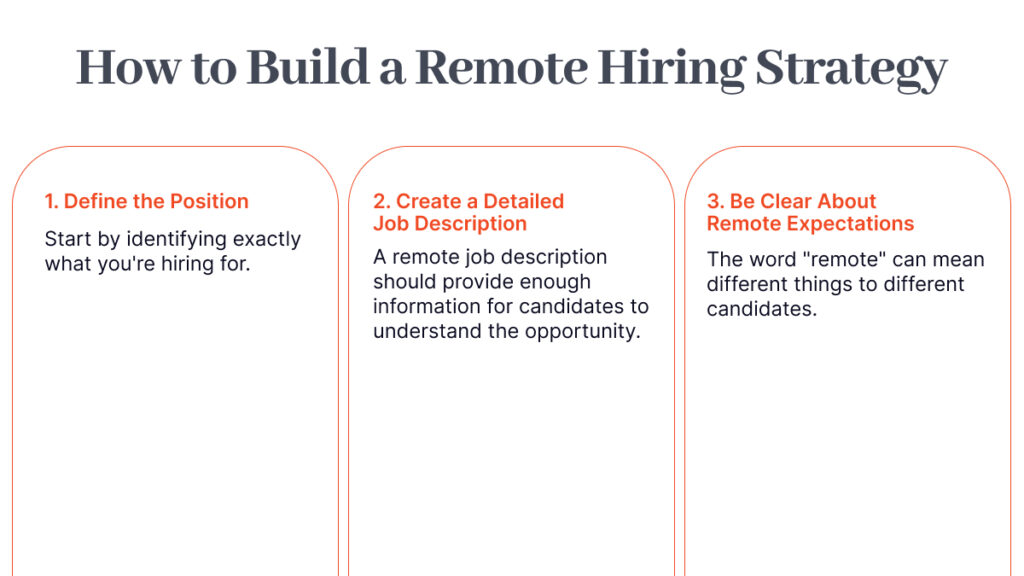
How to Build a Remote Hiring Strategy
Successful remote recruitment starts with a strategy.
Instead of immediately posting vacancies, determine what your company needs and how you intend to evaluate candidates.
01. Define the Position
Start by identifying exactly what you're hiring for.
Determine:
- Job title
- Responsibilities
- Required skills
- Preferred skills
- Experience level
- Employment type
- Compensation
- Working hours
- Location requirements
- Remote-work expectations
The more clearly you define the position, the easier it becomes to attract suitable applicants.
02. Create a Detailed Job Description
A remote job description should provide enough information for candidates to understand the opportunity.
Include a short introduction to your company and explain why you're hiring.
Then describe the responsibilities and requirements.
For technical positions, include the relevant technology stack.
For example:
Remote Full-Stack Developer
Required skills:
- JavaScript
- React
- Node.js
- REST APIs
- Git
- Database experience
This is much more useful than simply writing "experienced developer required."
03. Be Clear About Remote Expectations
The word "remote" can mean different things to different candidates.
Your job posting should explain what remote work means within your organization.
Mention:
- Accepted locations
- Time-zone requirements
- Core working hours
- Meeting expectations
- Whether travel is required
- Whether the company provides equipment
- Whether the role is fully remote or hybrid
Clear information can prevent unsuitable applications and reduce confusion later in the hiring process.
Where Should Employers Post Remote Jobs?
Choosing the right recruitment channel is an important part of remote hiring.
Employers can use:
- General job boards
- Remote job boards
- Professional networking platforms
- Developer job boards
- Recruitment agencies
- Online communities
- Employee referrals
- Industry-specific hiring platforms
If your company is hiring technical professionals, a specialized technology job board can help you reach a more relevant audience.
CodingProfessors provides employers with a platform for posting technology and remote job opportunities, helping companies promote vacancies to professionals interested in digital and technology careers.
Why a Specialized Job Board Can Help
A general job website may expose your vacancy to a large audience, but not everyone will have the skills you're looking for.
When hiring a software developer, for example, you want applicants who understand programming and development.
A specialized developer job board can make your recruitment efforts more targeted.
This can be particularly useful for employers looking for:
- Remote developers
- Software engineers
- Programmers
- Web developers
- Technical designers
- IT professionals
- Digital specialists
The objective should not simply be more applications. It should be more relevant applications.
How to Find Qualified Remote Candidates
Once your job is published, you'll need a process for identifying qualified candidates.
Start by reviewing applications against the essential requirements.
Don't automatically reject someone because they don't match every preferred skill.
Instead, look at the candidate's overall experience.
Review Their Previous Work
For developers and designers, previous work can provide valuable insight.
Depending on the position, consider reviewing:
- Portfolio websites
- GitHub repositories
- Previous projects
- Case studies
- Open-source contributions
- Applications they've built
- Professional experience
Practical work can sometimes reveal capabilities that aren't obvious from a resume.
Technical Screening for Remote Employees
Technical positions often require an additional assessment stage.
Depending on the role, employers might evaluate:
- Programming knowledge
- Problem-solving
- Code quality
- System design
- Debugging
- Technical decision-making
- Framework knowledge
- Database skills
A practical assessment should reflect the actual responsibilities of the job.
Avoid unnecessarily difficult tests that don't relate to the position.
Candidates are evaluating employers too.
A simple, relevant assessment can provide useful information without making the hiring process unnecessarily long.
Evaluate Communication Skills
Remote employees need to communicate effectively.
Because they aren't sitting beside their colleagues every day, written and verbal communication becomes particularly important.
Look for candidates who can:
- Explain ideas clearly
- Communicate progress
- Ask questions
- Report problems
- Document work
- Collaborate with teammates
- Participate in remote meetings
- Work independently
Technical expertise and communication ability should both be considered during the hiring process.
Consider Time Zones
Time zones are one of the biggest practical considerations when hiring remotely.
A distributed team may include employees working across several regions.
That doesn't necessarily mean everyone needs to work identical hours.
Instead, establish a reasonable period of overlap for important meetings and collaboration.
For example, your company could establish four core hours when the entire team should be available while allowing employees flexibility outside those hours.
Include these expectations in the job description.
Understand International Hiring Requirements
If your company plans to hire internationally, there are additional considerations.
These can include:
- Employment laws
- Contractor agreements
- Tax requirements
- Payroll
- Intellectual property
- Data protection
- Benefits
- Local regulations
The exact requirements depend on the countries involved.
Before employing someone internationally, companies should make sure their hiring and payment arrangements comply with applicable regulations.
How to Create an Efficient Remote Hiring Process
A complicated hiring process can cause strong candidates to lose interest.
A straightforward process could look like this:
Stage 1: Job Application
Candidates submit their resume, portfolio, or other requested information.
Stage 2: Initial Screening
Review the candidate's experience and qualifications.
Stage 3: First Interview
Discuss the candidate's background, communication style, availability, and expectations.
Stage 4: Technical Assessment
Evaluate relevant technical abilities where necessary.
Stage 5: Final Interview
Discuss the position, team, responsibilities, compensation, and company expectations.
Stage 6: Offer
Move quickly once you've identified the right candidate.
The exact process will vary by company, but keeping it organized and transparent can improve the experience for everyone.
How Employers Can Attract Better Remote Candidates
Remote professionals often have many opportunities available to them.
A job listing therefore needs to communicate more than just a list of requirements.
Explain why someone should want to work with your company.
Consider highlighting:
Flexible Work
Explain how flexible your remote model is.
Interesting Projects
Tell candidates what they'll actually be building or working on.
Career Development
Mention opportunities to learn, grow, and take on responsibility.
Compensation and Benefits
Be transparent about salary and relevant benefits.
Company Culture
Explain how your remote team communicates and collaborates.
Impact
Show candidates how their work contributes to the company.
A compelling job description can make your vacancy stand out without relying on exaggerated claims.
Remote Hiring Mistakes Employers Should Avoid
Hiring based only on a resume
A resume is useful, but it doesn't tell you everything about a candidate.
Consider experience, portfolio work, interviews, and practical assessments.
Making the requirements unrealistic
Requiring every possible technology can shrink your candidate pool unnecessarily.
Separate essential skills from preferred qualifications.
Not mentioning compensation
When possible, provide a salary range or clearly explain the compensation structure.
Ignoring communication
Remote work requires strong communication and collaboration.
Making the process too long
Strong candidates may move on if your hiring process takes weeks without clear communication.
Being unclear about remote work
Specify where candidates can work and when they need to be available.
Building a Remote Team After Hiring
Remote hiring doesn't end when the candidate accepts the offer.
The onboarding process is equally important.
Provide new employees with:
- Company information
- Product documentation
- Technical documentation
- Access to required tools
- Project information
- Team introductions
- Communication guidelines
- Development processes
A structured onboarding process can help remote employees become productive more quickly.
Create a Documentation Culture
Documentation should be part of everyday work.
Important decisions, processes, technical information, and project requirements should be documented rather than kept exclusively in private conversations.
This makes information easier for remote employees to access.
Establish Clear Communication Rules
Your team should know:
- Which platform to use for messages
- Where tasks are assigned
- Where documentation is stored
- How meetings are scheduled
- How urgent problems are communicated
Clear communication reduces unnecessary interruptions and confusion.
Why Employers Should Consider CodingProfessors
Finding the right recruitment channel can make remote hiring more efficient.
CodingProfessors provides employers with a technology-focused platform where companies can publish opportunities for developers and other digital professionals.
If your company is looking to hire remote developers, software engineers, programmers, designers, or technology specialists, publishing your vacancy on a relevant job board can help you reach a more targeted audience.
Instead of relying exclusively on broad recruitment channels, employers can use CodingProfessors as part of a focused technology hiring strategy.
Final Thoughts
Remote hiring gives companies access to a much wider talent pool, but successful recruitment requires planning.
Employers should define their roles clearly, create useful job descriptions, choose relevant hiring platforms, evaluate technical and communication skills, and establish transparent expectations around remote work.
The right strategy can help companies move beyond simply finding applicants and focus on finding qualified remote talent.
For businesses hiring developers, engineers, designers, and other technology professionals, CodingProfessors provides a focused place to publish remote and technology-related opportunities.
Ready to hire your next remote professional? Post your job on CodingProfessors and reach technology talent looking for their next opportunity.
Frequently Asked Questions
What is the best way to hire remote employees?
Start by defining the position and remote-work requirements, then create a detailed job description and publish it on relevant hiring platforms. Screen candidates based on experience, skills, communication, and their ability to work independently.
How can employers find qualified remote candidates?
Employers can use remote job boards, developer job boards, professional networks, referrals, recruitment agencies, and industry-specific platforms. For technical positions, specialized technology platforms can provide access to a more relevant audience.
What should a remote job description include?
A remote job description should include the job title, responsibilities, required skills, preferred qualifications, compensation, benefits, working hours, location requirements, remote expectations, and application process.
How do you hire remote developers?
Companies can hire remote developers by defining the required technology skills, publishing a clear developer job posting, reviewing portfolios and experience, conducting interviews, and using practical technical assessments.
What should employers consider when hiring internationally?
Employers should consider employment laws, taxes, contracts, payroll, intellectual property, data protection, working hours, and other country-specific requirements.
How long should a remote hiring process take?
There is no universal timeline, but employers should avoid unnecessary delays. A clearly defined process with timely communication can help prevent qualified candidates from leaving the process.

About the Author
Abdul Rehman — Co-Founder & Technical Director, Coding Professors
Abdul Rehman is a web designer and engineer with 3+ years of experience in high-end web design and development. As Co-Founder of Coding Professors, he focuses on making technology careers more accessible through practical guidance, mentorship, and industry-focused resources.